24 December 2007

Lakota Nation Sovereignty

LAKOTALakotaMitaku Oyasin: We Are All Related
MEDIA ADVISORY Immediate Release: 19 December 2007
Media Contacts: Naomi Archer,
Communications Liaison (828) 230-1404
lakotafree@gmail.com Freedom!

Lakota Sioux Indians Declare Sovereign Nation Status
Photobucket
Washington D.C. – Lakota Sioux Indian representatives declared sovereign nation status today in Washington D.C. following Monday’s withdrawal from all previously signed treaties with the United States Government. The withdrawal, hand delivered to Daniel Turner, Deputy Director of Public Liaison at the State Department, immediately and irrevocably ends all agreements between the Lakota Sioux Nation of Indians and the United States Government outlined in the 1851 and 1868 Treaties at Fort Laramie Wyoming. “This is an historic day for our Lakota people,” declared Russell Means, Itacan of Lakota. “United States colonial rule is at its end!” “Today is a historic day and our forefathers speak through us. Our Forefathers made the treaties in good faith with the sacred Canupa and with the knowledge of the Great Spirit,” shared Garry Rowland from Wounded Knee. “They never honored the treaties, that’s the reason we are here today.” The four member Lakota delegation traveled to Washington D.C. culminating years of internal discussion among treaty representatives of the various Lakota communities. Delegation members included well known activist and actor Russell Means, Women of All Red Nations (WARN) founder Phyllis Young, Oglala Lakota Strong Heart Society leader Duane Martin Sr., and Garry Rowland, Leader Chief Big Foot Riders. Means, Rowland, Martin Sr. were all members of the 1973 Wounded Knee takeover. “In order to stop the continuous taking of our resources – people, land, water and children- we have no choice but to claim our own destiny,” said Phyllis Young, a former Indigenous representative to the United Nations and representative from Standing Rock. Property ownership in the five state area of Lakota now takes center stage. Parts of North and South Dakota, Nebraska, Wyoming and Montana have been illegally homesteaded for years despite knowledge of Lakota as predecessor sovereign [historic owner]. Lakota representatives say if the United States does not enter into immediate diplomatic negotiations, liens will be filed on real estate transactions in the five state region, clouding title over literally thousands of square miles of land and property. Young added, “The actions of Lakota are not intended to embarrass the United States but to simply save the lives of our people”. Following Monday’s withdrawal at the State Department, the four Lakota Itacan representatives have been meeting with foreign embassy officials in order to hasten their official return to the Family of Nations. Lakota’s efforts are gaining traction as Bolivia, home to Indigenous President Evo Morales, shared they are “very, very interested in the Lakota case” while Venezuela received the Lakota delegation with “respect and solidarity.” “Our meetings have been fruitful and we hope to work with these countries for better relations,” explained Garry Rowland. “As a nation, we have equal status within the national community.” Education, energy and justice now take top priority in emerging Lakota. “Cultural immersion education is crucial as a next step to protect our language, culture and sovereignty,” said Means. “Energy independence using solar, wind, geothermal, and sugar beets enables Lakota to protect our freedom and provide electricity and heating to our people.” The Lakota reservations are among the most impoverished areas in North America, a shameful legacy of broken treaties and apartheid policies. Lakota has the highest death rate in the United States and Lakota men have the lowest life expectancy of any nation on earth, excluding AIDS, at approximately 44 years. Lakota infant mortality rate is five times the United States average and teen suicide rates 150% more than national average . 97% of Lakota people live below the poverty line and unemployment hovers near 85%. “After 150 years of colonial enforcement, when you back people into a corner there is only one alternative,” emphasized Duane Martin Sr. “The only alternative is to bring freedom into its existence by taking it back to the love of freedom, to our lifeway.” We are the freedom loving Lakota from the Sioux Indian reservations of Nebraska, North Dakota, South Dakota and Montana who have suffered from cultural and physical genocide in the colonial apartheid system we have been forced to live under. We are in Washington DC to withdraw from the constitutionally mandated treaties to become a free and independent country. We are alerting the Family of Nations we have now reassumed our freedom and independence with the backing of Natural, International, and United States law. For more information, please visit our new website at www.lakotafreedom.com.
###

16 December 2007

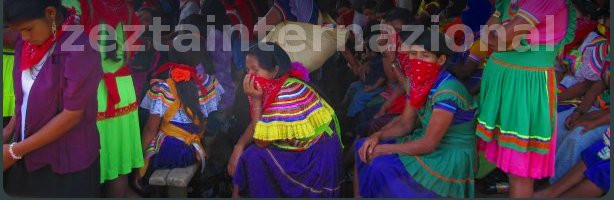
3rd Encuentro of the Zapatista Peoples with the Peoples of the World, Comandanta Ramona and the women Zapatistas


English translation of Compañera Everilda’s words convoking the 3rd Encuentro of the Zapatista Peoples with the Peoples of the World, Comandanta Ramona and the women Zapatistas:

Compañeros and compañeras of Mexico and the world. Good evening to all of you. With this Second Encounter of the Zapatista Peoples with the Peoples of the World we are very energized, with much responsibility and this worries us greatly. It makes us think. How there is much that we would like to say in this encuentro but scarcely find the time to share what we Zapatista communities are doing and there remain things for us to share, especially us women Zapatistas. Because of this we wish to say with anticipation that these words will remain well-guarded by us while you go to inform our compañeros y compañeras in your communities of what you have already come and heard so that the rest who are not here can be informed.

But we think it’s better at once that you already bring the message from us women Zapatistas that we convoke the Third Encounter of the Zapatista Peoples with the Peoples of the World, and the principle and unique theme will be the women Zapatistas, especially for us women Zapatistas of the Zapatista communities to gather with compañeras from México and the world.

We are going to speak, us women Zapatistas, with compañeras from Mexico and the world and you will be able to ask questions of how we organize ourselves, the women Zapatistas, more directly with women. We are going to ask the compañeros men Zapatistas that they help us with logistical questions. Compañeros from Mexico and the world may also come to hear us, but remain silent [calladitos], same as our compañeros men Zapatistas.

This Third Encuentro, as it will be especially of the women Zapatistas, will be dedicated to Comandanta Ramona, and will take her name. Thus it is like this: Third Encuentro of the Zapatista Peoples with the Peoples of the World: Comandanta Ramona and the women Zapatistas.

Bring this message to the rest of the compañeras. That they are prepared. At the same time, that they go to tell their spouses that they will have to take care of the house, the kids, and pets for a few days, while they leave and gather with the women Zapatistas to organize ourselves on how to fight against capitalism and neoliberalism.

This Third Encuentro of the women Zapatistas we think will happen around the last days of December 2007. We are consulting with the compañeras and compañeros of the Good Government Council of the caracol of La Garrucha and the community of La Garrucha, which is the seat of the caracol, if they will permit us to have our Third Encuentro there.

We’ll confirm later. We ask that you watch our Zezta Internazional and Enlace Zapatista internet pages, the Intergalactic Commission of the Sixth Commission of the Other Campaign.

The days we are thinking of:
Arrive the day of December 28 in the Caracol of La Garrucha and register;
December 29, 30, 31: plenary workshops of the Zapatista women with time for questions from the women of the world,
January 1: Celebration of our 14th anniversary of the beginning of the uprising of these dignified lands.

This is the invitation, compañeros y compañeras. We will be waiting here as always by the doors.

http://zeztainternazional.ezln.org.mx/?p=18

www.ezln.org.mx


Comandanta Ramona, 1959-2006


In 1993, Comandanta Ramona, together with Major Ana María, extensively consulted indigenous Zapatista communities (back then, still underground and not public) about the exploitation of women and subsequently penned the Revolutionary Laws of Women. On March 8 of that year, the Revolutionary Laws were passed.

Ramona was a woman charged with significant responsibilities, such as having been entrusted with the military leadership in San Cristóbal during the uprising in 1994. In February of that year and after the Zapatistas called a cease-fire to the twelve-day long uprising in response to mass peace marches, Ramona was the first Zapatista representative to speak during peace talks with the government. Two years later, when the Mexican authorities forbade the Zapatistas from participating in the National Indigenous Congress in Mexico City, the frail and ill-struck Ramona was asked to represent the Zapatistas. The plan worked as the government conceded to Ramona and she went on to represent the Zapatistas, speaking in front of 100,000 supporters in Mexico City’s Zocalo during the important nation-wide indigenous gathering.

The Mexican government, baffled by the popularity of a poor indigenous woman, made numerous attempts to undermine her influence. In 1997, it went so far as to state that the rebel leader had died and when she made public appearances that proved otherwise, authorities accused the Zapatistas of having used a “double.”

Comandanta Ramona passed on January 6th, 2006, after a decade-long bout with cancer of the kidney. Ramona's death is reflective of a health care crisis that the impoverished indigenous communities of Chiapas continue to suffer from. In the highlands of the southeastern Mexican state, where most of Chiapas’ indigenous residents live, there are no hospitals. The state government has promised for years to build a hospital in San Andrés Larráinzar (the same town that peace accords between the Zapatistas and the Mexican federal government were signed in 1996 but never implemented). However, the promise to build such a hospital has not been acted upon and Chiapas continues to lack crucial health care resources in its remote regions. Only in San Cristóbal, which is anywhere between two and twelve hours away from most indigenous communities, can women access preventative studies that could save the lives of women with early detections of cancer. In addition to the lack of hospitals, medical costs are often prohibitive to many of Chiapas’s poor and infirm.

Choking back tears, Subcomandante Marcos made the public announcement of Ramona’s death in the midst of the Chiapas segment of the nationwide six month Zapatista led “Other Campaign.”“I want everybody to listen to what I am about to say without any interruptions. Comandanta Ramona died yesterday… The world has lost one of those women it requires. Mexico has lost one of the combative women it needs and we, we have lost a piece of our heart.”

DO NOT LEAVE US ALONE!

Here is the title & citation for the article we read from on this week's show (15 December 2007):

Do Not Leave Us Alone!
Interview with Comandante Ramona,

Published in Double Jornada,
Monday, March 7, 1994

article link on the web:
http://www.eco.utexas.edu/Homepages/
Faculty/Cleaver/bookalone.html

14 December 2007

EZLN Revolutionary Laws for Women


1) Women, regardless of their race, creed, color, or political affiliation, have the right to participate in the revolutionary struggle in a way determined by their desire and ability.

2) Women have the right to work and receive a fair salary.

3) Women have the right to decide the number of children they will bear and care for.

4) Women have the right to participate in the affairs of the community and to hold positions of authority if they are freely and democratically elected.

5) Women and their children have the right to primary attention in the matters of health and nutrition.

6) Women have the right to education.

7) Women have the right to choose their partner and are not to be forced into marriage.

8) Women shall not be beaten or physically mistreated by their family members or by strangers. Rape and attempted rape will be severely punished.

9) Women will be able to occupy positions of leadership in the organization and to hold military ranks in the revolutionary armed forces.

10) Women will have all the rights and obligations elaborated in the revolutionary laws
and regulations.

09 December 2007

Prison Radio

www.prisonradio.org
Photo Sharing and Video Hosting at Photobucket
I hope you all know about this website with current and archived radio essays by Mumia Abu-Jamal.

Mumia Abu-Jamal is an award-winning journalist who chronicles the human condition. He has been a resident of Pennsylvania’s death row for twenty-five years. Writing from his solitary confinement cell his essays have reached a worldwide audience.

We hope you can make use of it on a regular basis to check-in with his crucial perspective on current events. Bless.

07 December 2007

Olga Gacia Poem

I havent heard words this fiery in along time. This comes from an untitled poem by Olga Garcia, a chicana poet from LA. The music was by a good friend added to the original audio track.
Link to her poem Protest:
http://mercuryred.com/
tracks/In%20Protest_8.25MB.mp3